
Products
Filters
Marketplace
- Document
GO SURF: decision support system for a participatory approach to forest management.
Decision Support Systems for Forestry (DSSF) are recognized as vital tools for implementing sustainable forest management and providing multiple ecosystem services.
- Guidance
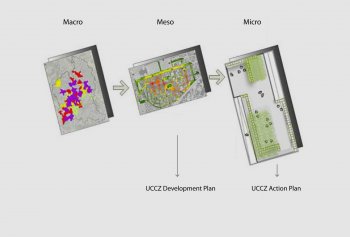
Urban Climate Comfort Zones
Guidelines for tackling heat island effects of urban open spaces, identifying prior areas of concern and proposing measures to enhance thermal comfort, micro-climate, amenity value and biodiversity in urban regions (with strategically distributed green spaces).

- Document
- Guidance
Biodiversity and ecosystem services: the foundation for human health and well-being - URBES Factsheet #2
Human beings are an integral and inseparable part of the natural world. Our existence and health ultimately depends on the integrity and functioning of ecosystems. This URBES factsheet presents research findings and policy recommendations which underline the value of biodiversity and ecosystem
- Report
Nature-based solutions for flood mitigation and coastal resilience: Analysis of EU-funded projects
This document summarises outcomes relating to flood mitigation and coastal resilience from the report ‘Nature-based Solutions: State of the Art in EU-funded Projects’ (Wild et al. (Eds.) 2020) prepared through the EC’s Valorisation of NbS Projects Initiative. EU research and innovation projects
- Web platform
Sustainable Infrastructure Tool Navigator
The Sustainable Infrastructure Tool Navigator was designed to help users identify the most relevant tools for their needs and goals. You can search our database by keyword or filter by types of tools, sectors and infrastructure lifecycle phases, amongst other things. Detailed information on each
- Document
- Guidance
Conservation of threatened insects in Europe
The "Conservation of threatened insects in Europe" policy brief is focusing on the conservation of threathened and vulnerable insects in the context of changing land use and climate. This brief builds on the BiodivERsA-funded CLIMIT project, lead by Dr. Josef Settele. The brief gives
- Document

- Document
- Training
Method Factsheet - Species Distribution Models
Species distribution models (SDMs) (Franklin, 2009) have shown great potential in helping to achieve conservation planning goals by refining our knowledge of species distributions (Jetz et al., 2012). SDMs extrapolate species distribution data in space and time, usually based on a statistical
- Consultancy
- Software
Map viewer (Web Map Service)
Share your georeferenced contents with this map visualization tool
- Document
- Guidance
OpenNESS Synthesis paper: Indicators for ecosystem services
An indicator is a quantitative measure which represents a complex system or phenomenon. Indicators are key elements in policies for goal formulation and evaluation of achievements, as well as simplification of information and communication. There is a long tradition of applying indicators in a
- Document
Valuing Inclusion and Diversity, Embracing Uncertainty: Ways Forward for Nature-based Solutions
There is a growing consensus that working with nature can help to address the pressing interlinked climate and biodiversity challenges, whilst ensuring and enhancing human well-being. Though being driven primarily by climate change mitigation and increasingly adaptation, Nature-based Solutions (NbS

- Paper
Restoration and repair of Earth's damaged ecosystems
Given that few ecosystems on the Earth have been unaffected by humans, restoring them holds great promise for stemming the biodiversity crisis and ensuring ecosystem services are provided to humanity. Nonetheless, few studies have documented the recovery of ecosystems globally or the rates at which
- Document
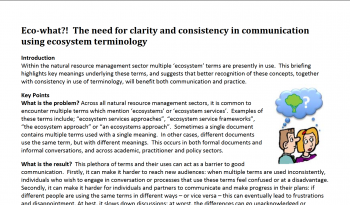
Eco-what?! The need for clarity and consistency in communication using ecosystem terminology.
Within the natural resource management sector multiple ‘ecosystem’ terms are presently in use. This briefing highlights key meanings underlying these terms, and suggests that better recognition of these concepts, together with consistency in use of terminology, will benefit both communication and
- Document
- Guidance
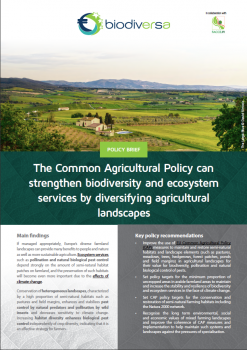
The Common Agricultural Policy can strengthen biodiversity and ecosystem services by diversifying agricultural landscapes
“The Common Agricultural Policy can strengthen biodiversity and ecosystem services by diversifying agricultural landscapes” is based on the combined results of the FARMLAND, APPEAL, CONNECT, EC21C and ECODEAL projects, funded by BiodivERsA and FACCE-JPI. This 4-page brief presents key

- Paper
Green, hybrid, or grey disaster risk reduction measures: what shapes public preferences for nature-based solutions?
The OPERANDUM project has the primary aim of reducing risk from hydrometeorological hazards using NbS across Europe. It is unclear what DRR measures at-risk individuals may prefer on the green-hybrid-grey spectrum and what shapes their preferences. This study investigates the other factors,
- Document
- Guidance
Addressing Climate Change in Cities – Policy Instruments to Promote Urban Nature-based Solutions
This guidance document responds to exisiting gaps and highlights a range of policy and supporting instruments relevant for NbS design, implementation and maintenance. Policy instruments include regulations, strategies, programmes, action plans and financial incentives. The guidance aims to support
- Document
- Guidance
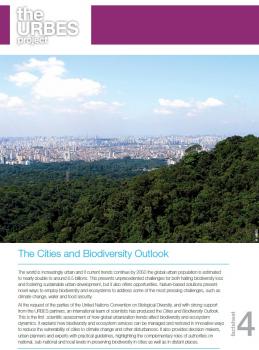
The Cities and Biodiversity Outlook - URBES Factsheet #4
This Factsheet highlights some of the mian highlights from the Cities and Biodiversity Outlook - the first scientific assessment of how global urbanization trends affect biodiversity and ecosystem dynamics. It explains how biodiversity and ecosystem services can be managed and restored in
- Document
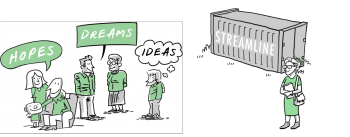
STREAMLINE
STREAMLINE is a new format for semi-structured, one-on-one interviews. In its current form STREAMLINE consists of a set of colorful, laminated A3 canvasses. Set in the future, each canvas invites the interviewee to set out their vision on a particular topic through a series of questions and tiles.
- Video
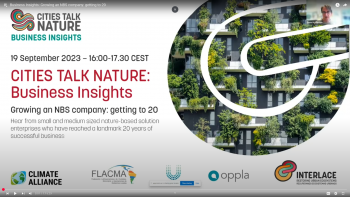
Business insight programme – webinars
As part of the CITIES TALK NATURE events, the INTERLACE project held a series of webinars to discuss business insights and opportunities for nature-based solutions (NbS) in Europe and Latin America. The webinars covered topics including: policy instruments for private NbS businesses, standards and

- Infographic
Nature-based solutions definition infographics
The adoption of the globally agreed definition of nature-based solutions by the UN Environment Assembly in March 2022 was a great boost to international collaboration. It placed the focus sharply on accelerating the implementation of nature-based solutions to tackle societal challenges. To help
- ‹ previous
- 27 of 41
- next ›