Products
Filters
Marketplace

- Document
Nature-Based Solutions and the Green Economy
Broadly speaking, nature-based solutions refer to “actions to protect, sustainably manage, and restore natural or modified ecosystems, that address societal challenges effectively and adaptively, simultaneously providing human well-being and biodiversity benefits.” There is significant and
- Document
- Slides
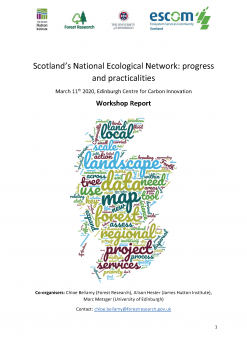
ESCom 2020 workshop: Scotland's National Ecological Network - progress and practicalities
This report summarises the contents and outputs from workshop ‘Scotland’s National Ecological Network: progress and practicalities’, held on the 11th March 2020 at the Edinburgh Centre for Carbon Innovation. Scotland’s Programme for Government 2019-2020 and Biodiversity Routemap to 2020 set

- Guidance
Natural Capital Protocol Toolkit
The Natural Capital Protocol Toolkit is an interactive database that helps businesses find the right tools to measure and value their impacts and dependencies on natural capital as they use the Natural Capital Protocol. By tools, we mean any resource, methodology or approach that is relevant to
- Document
Biomass accounting for Sustainable Forest Managment Plans using UAV data
Forest biomass and carbon are pivotal for multi-objective forest management, aiding in carbon sequestration and balance assessments.
- Software
LANDSCAPEization
The LANDSCAPEization toolkit allows the visualization of and reporting on ecosystem services (ES)- and non-ES-related information in real-time over spatial scales. Embedded in a decision support system, the provided information supports the communication of land use changes and their impacts on ES
- Consultancy
- Dataset
- Guidance
- Report
Leveraging Public Programmes with Socio-Economic and Development Objectives to Support Conservation and Restoration of Ecosystems
The Strategic Plan for Biodiversity 2011-2020 recognises that biodiversity underpins ecosystem functioning and the provision of ecosystem services that are essential for human well-being. The fourth Global Biodiversity Outlook underscores that biodiversity is still being lost and ecosystems

- Document
- Guidance
OpenNESS Synthesis paper: Ecosystem services: a gender perspective
The issue of gender and sustainability has mainly been approached from two different perspectives: the different role of women and men in contributing to sustainable pathways and the differential impacts of environmental degradation on women and men. Both are highly interconnected as the adaptation
- Video
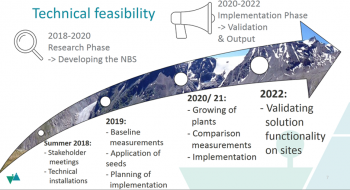
Kaunertal Valley field study - microbial assisted local seed mixtures to mitigate erosion on slopes
This video contains a visual explanation of the research work in Kaunertal Valley in the framework of the EU horizon 2020 PHUSICOS Project (PHUSICOS – ‘according to nature' solutions to reduce risks in mountain landscapes). Goal is to develop a height adapted and microbial assisted local seed
- Paper
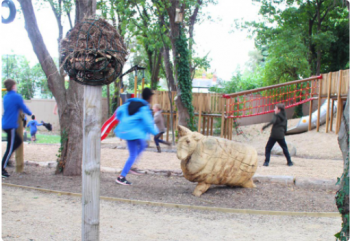
Providing contact with nature for young generation - A case study of preschools in the City of Poznań, Poland
Contact with nature is valuable for the health, wellbeing and development of children. Meanwhile, the urban environment and the contemporary urban lifestyle limit the opportunity for contact with nature. Given that children aged three to six years spend a significant amount of time in preschool, we
- Report
Report knowledge base/action framework Low carbon | High air quality NbS potentials
As the acronym already indicates, JUSTNature introduces the normative notion of justice. An initial analysis of the scope of nature-based solutions and the role of justice suggests that issues of social and environmental justice are only considered peripherally, and that so far no dedicated

- Guidance
NBS EduWORLD booklet: The School as NBS Living Lab
The NBS Living Labs create the right conditions to integrate actions that promote skills development and sustainability education, to innovate and open the schools to society.

- Guidance
Sub-urban Ecosystem Payments
Guidelines (including a toolkit) for assessing the value of the ecosystem services provided by natural areas/green infrastructure in suburban locations.
- Document
Conexus key learning factsheet series - Supporting Nature-based Solutions via Nature-Based Thinking
In response to critiques of Nature-based Solutions (NbS), we propose a holistic and systemic approach: Nature-Based Thinking (NBT). NBT emphasizes the inspiration from nature to foster sustainable urban development and conceives nature to be intertwined with people. NBT will engage local actors,
- Document
- Training
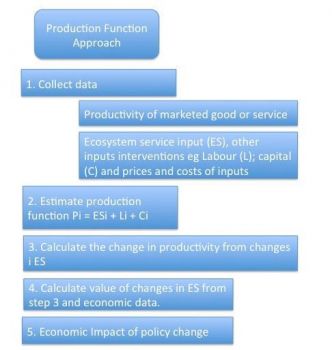
Method Factsheet - Production Function Approach
The production function approach (PFA) can be used in situations where a marketed good or service is produced with both man-made and ecosystem inputs. The PFA is a method designed to value indirect use values. It is highly appropriate for capturing ecological and monetary values, as well as
- Document
- Guidance
- Video
What is Ecosystem Restoration
Ecosystem restoration means assisting in the recovery of ecosystems that have been degraded or destroyed, as well as conserving the ecosystems that are still intact. Healthier ecosystems, with richer biodiversity, yield greater benefits such as more fertile soils, bigger yields of timber and fish,

- Consultancy
- Event
- Software
- Training
Belgium Ecosystem Services Network BEES
The Belgium Ecosystem Services (BEES) network is a community of practice, which connects research, practice and policy on ecosystem services and related issues by fostering exchange and real-life networking events.

- Dataset
Ecosystem types of Europe
The dataset combines the Corine based MAES ecosystem classes with the non-spatial EUNIS habitat classification for a better biological characterization of ecosystems across Europe. As such it represents probabilities of EUNIS habitat presence for each MAES ecosystem type.

- Consultancy
Social media listening
Extensive methods of socio cultural valuation. Just taking profit of the fact that people explain a lot what do they like and do on social networks. Hashtags and geotags from Instagram, Twitter, and Facebbok can be great location based sources of information! Text analysis software can help to
- Document
Technology at the service of forest renewal - Mapping with drone and GPS to stake out the stand
Develop plantation management methods that meet the social and environmental expectations : a new mapping and staking method, based on the use of a drone and a centimetre-accurate GPS.
- Document
- Training
Mapping Biodiversity Priorities
This document sets out a practical, science-based approach to spatial biodiversity assessment and prioritisation, which can be applied at the national level in any country. It is especially useful for countries that are both biodiversity rich and resource constrained, where difficult choices have
- ‹ previous
- 29 of 41
- next ›