
Products
Filters
Marketplace
- Empty
Tool Assessor
Tool Assessor is the UK's online resource on analytical tools that link the environment and society A wide range of tools for analysing ecosystem services, natural capital and green infrastructure have been developed in recent years in the UK and globally, and more are in development.

- Empty
Common Action Plan on clustering activities D1.3
This deliverable presents a summary of planned joint activities among the cluster of projects funded under the EU Horizon call H2020 SC5-14-2019 (Visionary and integrated solutions to improve well-being and health in cities).

- Empty
AlpES - Alpine Ecosystem Services
The AlpES project's overall objective is to introduce ecosystem services as a regional/transnational environmental governance framework and train and support the AlpES target groups in understanding, valuing and managing them.
- Document
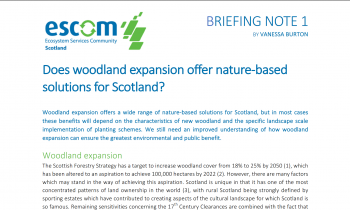
Does woodland expansion offer nature-based solutions for Scotland?
Woodland expansion offers a wide range of nature-based solutions for Scotland, but in most cases these benefits will depend on the characteristics of new woodland and the specific landscape scale implementation of planting schemes. We still need an improved understanding of how woodland expansion

- Document
Deliberative mapping of ecosystem services within and around Donana National Park (SW Spain) in relation to land use change
The establishment of protected areas is one of the main strategies for preserving biodiversity from land use transformation. However, a great number of protected areas are becoming isolated due to land use changes in their surroundings.
- Document
- Training
OpenNESS Glossary
This glossary was developed to provide some working definitions of terms related to ecosystem services and natural capital and their applications so that they could be 'tested' in the context of OpenNESS. The aim of OpenNESS is to operationalize the concepts of Ecosystem Services (ES) and

- Blog
URBAN GreenUP Nature-based solution selection tool
This tool is a decision support tool – it’s designed to give suggestions that may help you choose the right Nature-based solution (NbS) for you, based on both your city’s capabilities, and the outcomes you’d like to achieve. It can also be helpful in figuring out how to build your capacity to
- Report
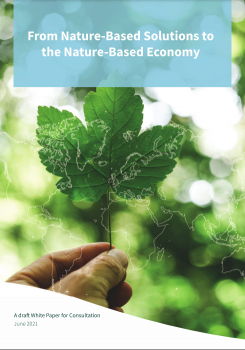
From Nature-based Solutions to the Nature-based Economy - Delivering the Green Deal for Europe (Draft White Paper for consultation)
Decades of research and more recently public policy recognise that current economic practices are not compatible with a healthy planet. The European Green Deal aims to decouple economic growth from resource usage, decarbonise industry and do this in a fair and just way for society. Nature-based

- Training
Phusicos NbS Governance Game
The newly developed PHUSICOS simulation is a serious game. It was developed as part of Work Package 6 on learning innovation and aims to simulate the complex governance setting of stakeholders. Serious games owe their name to the fact that they are designed with a purpose that goes beyond the

- Web platform
Naturaleza Transformativa
Naturaleza Transformativa: soluciones para la biodiversidad y las personas en Latinoamérica y el Caribe, emerge como una plataforma digital de conocimiento e innovación para la comunidad científica y de práctica en la región. Está diseñada como un repositorio dinámico de información y experiencias
- Document
- Guidance
OpenNESS Synthesis paper: Scenario building and its application
The term scenario is widely used in different ways and contexts, making it necessary to arrive at a common understanding of how the term is used. Based on the OpenNESS Glossary, scenarios are defined as "plausible, but simplified descriptions of how the future may develop, based on a coherent

- Paper
On the need for a multi-dimensional framework to measure accessibility to urban green
With the recent expansion of urban greening interventions, the definition of spatial indicators to measure the provision of urban greenery has become pivotal in informing the policy-design process. By analyzing the stability of the population and area rankings induced by several indicators of green
- Guidance
Sub-urban Infrastructure Payments
Guidelines (including a toolkit) for estimating the funds needed for the development of primary and secondary infrastructure in sub-urban areas.
- Guidance
GIZ ValuES - Report on Indicators for Managing Ecosystem Services - Options & Examples
This report gives guidance for seeking information that supports the integration of ecosystem services into policy and public management. We present for each ecosystem service a succinct selection of literature and further sources, which describe example indicators for approximating its (bio-
- Report
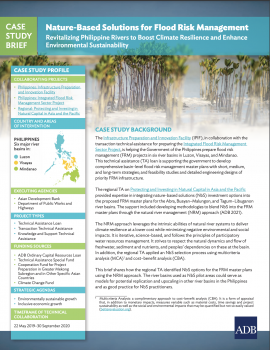
Nature-Based Solutions for Flood Risk Management
The Infrastructure Preparation and Innovation Facility (IPIF), in collaboration with the transaction technical assistance for preparing the Integrated Flood Risk Management Sector Project, is helping the Government of the Philippines prepare flood risk management (FRM) projects in six river basins
- Policy Brief
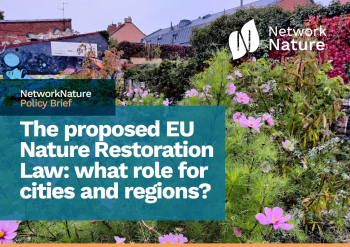
The proposed EU Nature Restoration Law: what role for cities and regions?
This policy brief takes a fresh look at the implications of the European Commission’s proposed Nature Restoration Law for cities, regions and local actors. The first of its kind, this paper looks at what the Law holds in store for these governments and authorities – actors on the front lines of the

- Empty
Natural environments, psychosocial health, and health behaviors in a crisis – A scoping review of the literature in the COVID-19 context
The COVID-19 outbreak led to major restrictions globally, affecting people’s psychosocial health and their health behaviors. Thus, the purpose of this scoping review was to summarize the available research regarding nature and health in the COVID-19 context. Overall, the findings indicate that

- Guidance
Governance Guidebook
The aim of this Guidebook is to outline a key aspect of how to embed nature-based solutions in your city – and that is governance. Governance is broader than government. It covers the legal frameworks, the formal and informal networks and organisations and the rules and policies related to the
- Document
- Paper
- Report
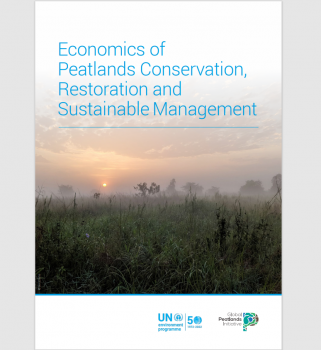
Economics of Peatlands Conservation, Restoration and Sustainable Management
Less than 3% of the Earth’s surface is covered by peatlands but they are the largest terrestrial organic carbon stock. Indeed, peatlands are capable to store twice as much carbon as in the world’s forests. Despite their potential, globally, peatlands are in decline with 11-15% of these ecosystems
- Guidance
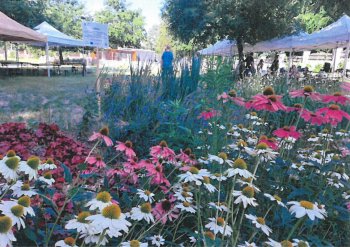
ZÖLD-KÉK INFRASTRUKTÚRA: Útmutató esőkertek építéséhez
"Az elmúlt években az éghajlati változások miatt olyan környezeti változásokkal kellett szembesülnünk, amelyek komoly negatív hatást gyakoroltak életünkre. Ezeknek a negatív hatásoknak az egyik oka a csapadék jellemzők megváltozása. Megoldást a szemléletváltás jelenthet, ami a csapadékvizek
- ‹ previous
- 4 of 41
- next ›