Products
Filters
Marketplace

- Report
Urban GreenUp info-pack: New strategy for Renaturing Cities through Nature Based Solutions
This guide presents an integrated methodology for the development of Renaturing Urban Plans (RUP). The goal is to help cities worldwide to increase environmental sustainability and to address climate, social and economic challenges via the local implementation of Nature-based solutions (NBSs).
- Document
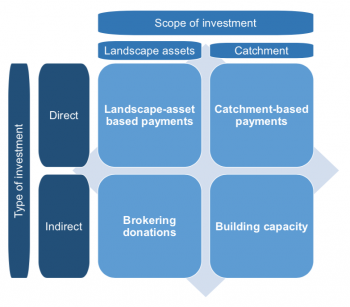
Understanding the potential for private sector investment in natural capital – lessons from the Spey catchment, Scotland
There is a growing recognition amongst policy-makers, conservation NGOs and the private sector that funding for land management needs to be increased and diversified to protect and restore biodiversity and natural capital in Scotland. However, effective mechanisms for enabling private investment by
- Document
Preference Assessment Factsheet
reference assessment is a direct and quantitative consultative method for analyzing perceptions, knowledge and associated value of ecosystem services demand or use (or even social motivations for maintaining the service) without using economic metrics. It could also be used to understand which
- Report
Nature-based solutions State of the art in EU-funded projects
This document summarises outcomes from the EC individual expert reports delivered through its ‘Valorisation of NbS Projects’ initiative. EU research and innovation projects were scanned for results pertaining to key areas such as biodiversity, climate change mitigation and adaptation (including
- Document
Using UAV photogrammetric data to support multi-objective forest management plans
In Italy and Europe, there is a growing demand for forest and agroforestry companies to prioritize multifunctionality and certification. The first step involves obtaining spatial data to derive multifunctionality indicators for developing multi-objective management plans.
- Document
- Guidance
OpenNESS Synthesis paper: Ecosystem services and human health
Synthesis paper on ecosystem services and human health. There may be scope for OpenNESS to demonstrate a benefit of the ecosystem services and natural capital concepts in shaping a more systemic understanding of how biodiversity supports health aspects of well-being.
- Document
- Guidance
OpenNESS Synthesis paper: Ecosystem service trade-offs and synergies
Despite its popularity, the intuitive definition of 'ES trade-offs' and its antonym 'ES synergies' lack conceptual clarity. When moving from theoretical concepts towards scientific comparison, more analytic definitions are required. In this SP, we further explore the trade-offs

- Event
- Slides
- Training
ZÖLD-KÉK INFRASTRUKTÚRA: "Zöldinfrastruktúra a 2021-2027-es programozási időszakban" című esemény előadás anyagai"
A 2021. októberében megrendezett Miniszterelnökség által szervezett "Zöldinfrastruktúra a 2021-2027-es programozási időszakban" című esemény előadás anyagai, előadók között többek között: Magyar Urbanisztikai Társaság, Innovációs és Technológiai Minisztérium, Balatonfelvidéki Nemzeti Park
- Web platform
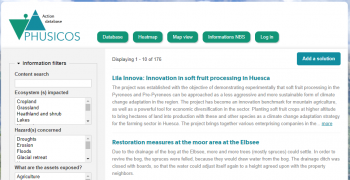
PHUSICOS Action Database
The PHUSICOS Action Database is a product innovation which establishes a comprehensive state-of-research evidence-base and information management platform. Implemented NBSs related to extreme hydro-meteorological events in rural and mountainous landscapes are accessible though this open-source

- Guidance
GIZ ValuES - Method Profile: Assessing flood prevention potential of wetlands
Wetlands can absorb excess water in cases of river flooding. This method can be used to estimate the retention capacity of wetlands for flood mitigation and thereby protecting downstream inhabitants. For this, the impact of water detention on peak flows is considered, as well as the extent and

- Document
Training for Forest Technicians, Researchers, and Employees on Fundraising and Communication Topics as Assets for Ecosystem Services Enhancement Projects.
The sale of sustainability credits and payment for ecosystem services, other than the traditional sale of timber, is an important objective and can be improved thanks to a good communication strategy and empowering specific communication skills.
- Report
Scaling Investments in Nature
This report, published by the World Economic Forum’s Global Future Council on Nature-Based Solutions, takes a practical look at the investment landscape for nature and nature-based solutions. In doing so, it charts out two complementary pathways for private-sector stakeholders: one, to mainstream

- Policy Brief
NbS Private sector upscaling and capacity building - PBF Workshop Summary 18 November 2022
The Policy Business Forum (PBF) consists of Nature-based Solutions (NbS) experts and knowledgeable stakeholders at the international, European, and national scale. The main aim of the PBF is to explore innovative ways to strengthen the science-policy-business nexus in order to exploit opportunities

- Paper
Using ecosystem services to measure the degree to which a solution is nature-based
There has been a recent surge of interest in Nature-based Solutions, a concept encompassing a broad suite of ideas that have arisen from the intersection of ecology, engineering, sociology and economics. Solutions founded in nature are promised to resolve many issues resulting from global change,

- Guidance
Process Design: An Explorer's Guide
Solving complex problems with innovative solutions isn’t easy, and just like an explorer embarking on a new journey, one should depart prepared with the right equipment. The main purpose of this guide is to equip readers with basic process management skills and ultimately to become more confident
- Document
- Training
Method Factsheet - Travel Cost Valuation
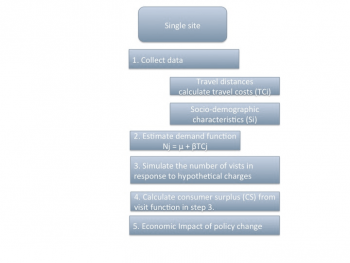
The travel cost methods (TCM) is based on the observation that recreational services can only be realised through physical access to nature. This implies that individuals seeking to enjoy the service will need to spend resources (time and money) to travel to the site. The travel activity is a

- Document
The Ecoregions of Italy
In Italy, ecoregion classification, based on detailed scientific data, represents a framework that is used to effectively address national strategies for sustainability and harmonise landscape planning according to European policies (Habitats Directive; European Landscape Convention; Pan-European
- Guidance
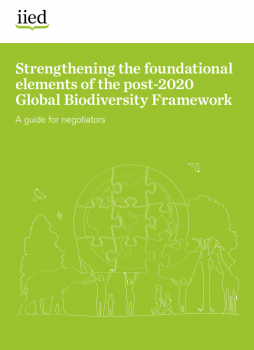
Strengthening the foundational elements of the post-2020 Global Biodiversity Framework
The post-2020 Global Biodiversity Framework (GBF) will be a major milestone in global agreements on biodiversity conservation, setting international ambition for the next decade. This guide seeks to support Parties to the Convention on Biological Diversity (CBD) who wish to strengthen the chapters

- Empty
Report on Cultivating Cities' Challenge Workshops, Urban Morphology and SWOT analyses
The Challenge Workshop in each cultivating city was the first opportunity for different stakeholders to come together to get to know each other and to learn about GoGreenRoutes. During the Challenge Workshop, stakeholders were invited to create a vision for the upcoming seedbed and NBS
- ‹ previous
- 35 of 41
- next ›