
Products
Filters
Marketplace

- Document
- Guidance
Cultural Ecosystem Services - URBES Factsheet #8
This factsheet illustrates how cultural ecosystem services offer a gateway to raising awareness of the wide range of ecosystem services provided by nature, their importance for quality of life and human health in cities, and their role in encouraging urban environmental stewardship.

- Document
- Guidance
OpenNESS Synthesis paper: Non-monetary valuation
To increase the applicability of NMV it is necessary to clarify the boundaries and the terminology of the field, and address considerations with regard to the context-specificity of non-monetary techniques.

- Document
- Guidance
- Infographic
- Paper
- Policy Brief
- Report
MEZŐGAZDASÁG: Tudástár a természetkímélő gazdálkodás témakörében
A közzétett tudásanyagokat a Natura 2000 hálózat égisze alatt publikálta a Magyar Madártani és Természetvédő Egyesület (MME) a természetkímélő gazdálkodás témakörében. Az MME célja a madarak védelmével hozzájárulni az emberi életminőség és a biológiai sokféleség megőrzéséhez Magyarországon.
- Training
ESLab services test and demonstration site
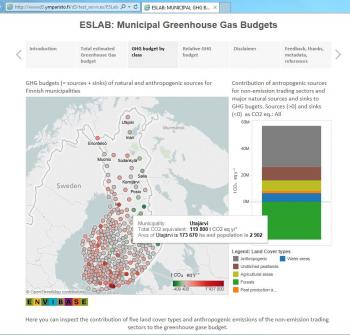
The test and demonstration version of ESLab services provide 1) visualization of municipal greenhouse gas budgets in Finland, and 2) High resolution carbon budget data for a pilot study region in southern Finland.
- Report
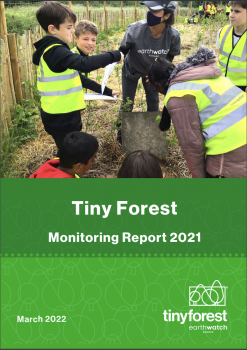
Tiny Forest: First monitoring report
Earthwatch Europe has published the first monitoring report for its Tiny Forest programme showcasing the first insights into the benefits to the environment and biodiversity that a Tiny Forest can provide in its early stages. The report highlights the vital role of the "super powerful

- Document
- Guidance
Eliciting Demand for Ecosystem Services: Results and User Guidance from the OPERAs Demand Synthesis Working Group
Based on experience in seven of the OPERAs Exemplar case studies, we summarize what the research team has learned about working with stakeholders to elicit demand for ecosystem services and put forth an eight-step framework for doing so. Each step of the framework includes examples from the OPERAs

- Paper
Study: The application of an environmental performance framework for climate adaptation innovations on two nature-based adaptations
In this paper, they introduce and test a framework to qualitatively assess the environmental impact of climate adaptation innovations with the ambition to facilitate the implementation of these adaptations. The framework was designed to enable continuous environmentally conscious benchmarking based
- Guidance
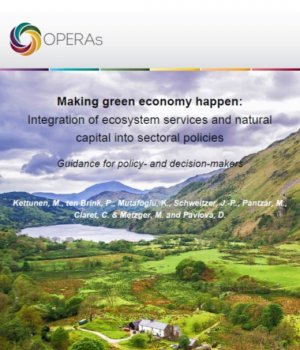
Making green economy happen: Integration of ecosystem services and natural capital into sectoral policies
The integration of ecosystem services and natural capital into the functioning of economic sectors provides a concrete means to initiate a shift towards green economy. This process starts with the integration of ecosystem services and natural capital into the policies governing the different

- Infographic
A Horizont 2020 kutatási projektjei TAM projektjei
A természetalapú megoldásokat (TAM) a természet inspirálja és támogatja. Ezek a megoldások költséghatékonyak, egyszerre nyújtanak környezeti, társadalmi és gazdasági előnyöket, és segítik a külső hatásokhoz való sikeres alkalmazkodás. A természetalapú megoldások a helyi adottságokhoz illeszkedő,
- Document
- Guidance
OpenNESS Synthesis paper: Human well-being
Human well-being (HWB) is a central component of the ecosystem services (ES) framework and in fact its major endpoint in terms of what the ES concept aims at. The question of what is meant by, and what specifically constitutes, HWB, is of major importance in any application of the ES concept.

- Guidance
Using ecosystem risk assessment science for ecosystem restoration: A guide to applying the Red List of Ecosystems to ecosystem restoration
This guide was developed to promote the application of the science of ecosystem risk assessment, which involves measuring the risk of ecosystem collapse, in ecosystem restoration. It explores how the IUCN Red List of Ecosystems and ecosystem restoration can be jointly deployed to reduce risk of
- Document
- Guidance
OpenNESS Synthesis paper: Stakeholder involvement
Stakeholder involvement is not only regarded as an essential element in environmental management and decision making, but also considered critical in the context of ecosystem services (ES).

- Event
OPERAs Webinar: How to link ecosystem services, knowledge, tools and practice?
The webinar highlighted the flow between knowledge, tools and practice through case material from the OPERAs exemplars and different tools. T

- Document
- Guidance
- Product
Guidelines on Implementation of Nature-Based Solutions Activities in Education for Starters
In response to the growing need for integrating the topic of nature-based solutions (NBS) in education, these guidelines have been developed to cater to educators with limited to no prior exposure to NBS concepts. This document outlines examples and recommendations to bridge the knowledge gap by

- Paper
Innovation in NbS Co-Desing and Implementation
Article published in Sustainability. From the published abstract: Impacts in the form of innovation and commercialization are essential components of publicly funded research projects. PHUSCOS ("According to Nature" in Greek), an EU Horizon 2020 Program (H2020) Innovation Action project

- Document
Conexus key learning factsheet series - Skills Gaps for Nature-based Solutions uptake in Europe and Latin America
Skill gaps hindering the implementation of Nature-based Solutions (NbS) are often pointed out as a challenge to larger scale NbS uptake. This factsheet presents the findings and key messages of an explorative study on skills and competence gaps among NbS professionals. Moreover, it introduces the
- Document
- Guidance
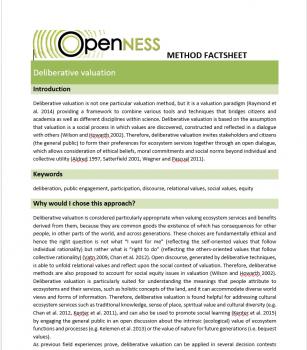
Deliberative valuation methodological guidelines
Deliberative valuation is not one particular valuation method, but it is a valuation paradigm (Raymond et al. 2014) providing a framework to combine various tools and techniques that bridges citizens and academia as well as different disciplines within science. Deliberative valuation invites
- ‹ previous
- 41 of 41