Community Involvement - Sofia
Submitted by Rose Galsworthy on 3 March 2017
Encouraging public participation in the planning and implementation processes of urban projects in Sofia.
Encouraging public participation in the planning and implementation processes of urban projects in Sofia.
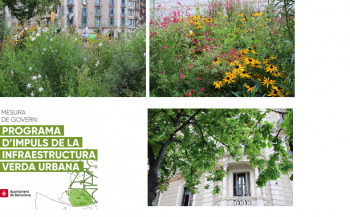
The Programme for Enhancing the Urban Green Infrastructure is an ambitious government measure approved in 2017. It establishes the main strategies for enhancing the quality and quantity of green infrastructure in Barcelona till 2030. Barcelona wants to renature the city and create, in this period, 165 ha of new green spaces, which increases the green spaces/inhabitant ratio by 1m2. As Barcelona is a compact city, there are various strategies to improve, transform or create new green spaces. The actions will take place at various urban scales (street, district or city scale) and...
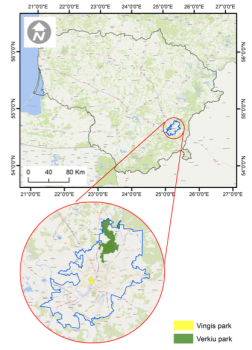
The aim of the project is to develop realistic indicators to evaluate, manage and develop performant Green and Blue infrastructure (GBIs) in cities and intensively managed landscapes. UrbanGaia explicitly focusses on analysis of ecological and socio-economic features of the many existing GBIs within a place-based and socio-ecological research framework. The project consists of three main approaches which converge in a transdisciplinary analysis of GBI performance: ecological science, political economic analysis and stakeholder co-creation.

Exploring how ecosystem services can be integrated in a land-use planning process using a real-life planning case. A special focus is on multifunctional green infrastructure and applying new tools to operationalise ecosystem services in the plans in a participatory way.

Conducting an integrated assessment and valuation of urban ecosystem services, which supports urban management and decision-making in Oslo. This scrutinises the potential and limitations of the concepts of ecosystem services and natural capital in an urban and Norwegian context.

The main objective of our BIOVEINS proposal is to use functional diversity (FD) to highlight the mechanisms underpinning the link between GBI, taxonomic diversity (TD) and ecosystem services (ESs) provisioning, and to provide, together with local stakeholders, the ecological and interdisciplinary knowledge to identify the critical features of GBI, to guide the establishment, management and restoration of GBI, and to mitigate the effects of major urban global challenges, like habitat fragmentation, air pollution, and urban heat island.
This main objective will be accomplished by...

This case study examines in particular the interface between four sets of plans and strategies, providing important context for further examination of meso- and micro-scale interventions covered in subsequent sections. This case also touches on other formally adopted plans and strategies only in relation to the above meso- and micro- scale initiatives, in an attempt to better understand contexts.

A network of attractive open spaces as a counterpoint to the region's grey infrastructure.
The vision is to create a network of attractive, accessible, welcoming and diverse open spaces that functions as a counterpoint to the region’s grey infrastructure.
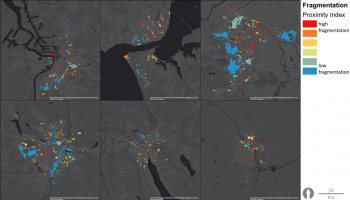
The main objective of our BIOVEINS proposal is to use functional diversity (FD) to highlight the mechanisms underpinning the link between GBI, taxonomic diversity (TD) and ecosystem services (ESs) provisioning, and to provide, together with local stakeholders, the ecological and interdisciplinary knowledge to identify the critical features of GBI, to guide the establishment, management and restoration of GBI, and to mitigate the effects of major urban global challenges, like habitat fragmentation, air pollution, and urban heat island.
This main objective will be accomplished by...

Protecting areas to protect biodiversity: The IBRM is home to several remarkable protected sites, high biodiversity richness and an important cultural heritage. However, pressures from human activities in the area are threatening these distinct values. Our aim is to use diverse data plus stakeholder input to understand the social and ecological system and design a multifunctional network of areas – that allow conservation, exploitation and restoration - and identify ideal sites for restoring degraded freshwater, coastal and marine ecosystems.
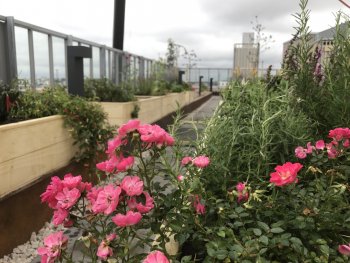
The objective of the project is to investigate the future possibilities of green area development, by exploring the functionality of green areas on the roofs of apartment buildings and to gain insight into the impacts green roofs may have on housing and the sense of community.
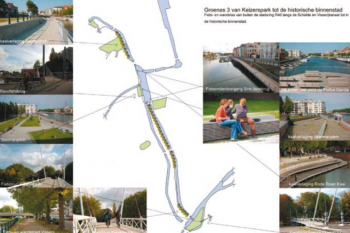
The aim is to develop a realistic framework of indicators to evaluate, manage and develop performant Urban Green-Blue Infrastructure (U-GBI) in cities and intensively managed landscapes. UrbanGaia explicitly focusses on analysis of ecological and socio-economic features of the many existing GBIs. The evaluation of one the green axis of the ecological network in Ghent will serve as a case study for the framework of indicators. Furthermore, policy, governance and management practices of U-GBI are analyzed to identify innovative approaches to GBI implementation and usage.
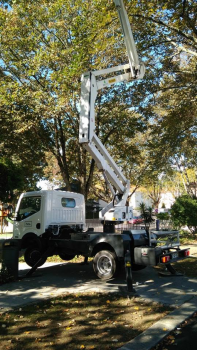
The aim is (i) to provide an assessment of the EcM community and functional group composition of urban trees, and of its environmental drivers, using next generation sequencing techniques; (ii) to relate specific EcM, or functional groups of EcM, to tree health, and tree ecosystem service delivery and resilience, using advanced noninvasive spectral and physiological sensing technology, diameter growth measurements, and urban biophysical modeling; and (iii) to develop and test (in situ & ex situ) a dedicated EcM-inoculum to improve urban tree health, and ecosystem service delivery and...

The main purpose of the roof is to offer an unique green environment to the residents in the house. In the project every surface, also on the ground below, is maximized with greenery. The greenery offers a range of ecosystem services which also benefits the neighbors and the city.

Demonstrating the benefits of incorporating a network of green spaces in the urban planning. This multifunctional "green infrastructure" network supplies ecosystem services and benefits to the city.

Controlling and mitigating the heat island effect in Arará slum, northern Rio de Janeiro, based on the development and monitoring of green roofs, using epiphytes or lithophytes. Given the common uses of cement or metal, tiles required the development of specific techniques and materials to allow for the growth of vegetation while keeping the overall weight low for safety.

The main objective of our BIOVEINS proposal is to use functional diversity (FD) to highlight the mechanisms underpinning the link between GBI, taxonomic diversity (TD) and ecosystem services (ESs) provisioning, and to provide, together with local stakeholders, the ecological and interdisciplinary knowledge to identify the critical features of GBI, to guide the establishment, management and restoration of GBI, and to mitigate the effects of major urban global challenges, like habitat fragmentation, air pollution, and urban heat island.
This main objective will be accomplished by...

Rapid urbanisation in the Philippines has given rise to many challenges as increasing infrastructure developments contribute to reduced open spaces and increased energy consumption.
Both the public and private construction sectors are responding by reshaping the cityscape and designing building structures that are as environmentally responsive as they are beautiful and compact. Now, buildings should not only be sturdy and spacious, they should also be efficient in energy consumption and adaptive to the changing environment.
LafargeHolcim Philippines (LafargeHolcim) has...

The main objective of our BIOVEINS proposal is to use functional diversity (FD) to highlight the mechanisms underpinning the link between GBI, taxonomic diversity (TD) and ecosystem services (ESs) provisioning, and to provide, together with local stakeholders, the ecological and interdisciplinary knowledge to identify the critical features of GBI, to guide the establishment, management and restoration of GBI, and to mitigate the effects of major urban global challenges, like habitat fragmentation, air pollution, and urban heat island.
This main objective will be accomplished by...
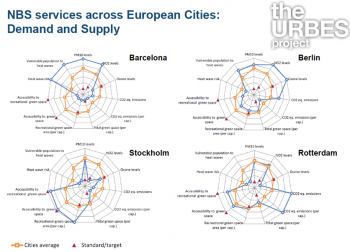
The URBES project focusses on functional diversity, urban ecosystem services and NbS, institutions, economics and resilience science and worked to translate research insights into principles, landscape designs and applications. It explores the drivers behind loss/enhancement of urban ecosystem services delivered by nature based solutions such as urban green space, monetary and non-monetary valuation of biodiversity and ecosystem services in the urban landscape and what are the most effective mechanisms for the governance of non-marketed ecosystem services.
In the Berlin case study,...

The main purpose of the roof is to offer an unique green environment to the residents in the house. In the project every surface, also on the ground below, is maximized with greenery. The greenery offers a range of ecosystem services which also benefits the neighbors and the city. The main purpose of the roof is to offer an unique green environment to the residents in the house. In the project every surface, also on the ground below, is maximized with greenery. The greenery offers a range of ecosystem services which also benefits the neighbors and the city.
“Let’s Crop the Diversity” (LCD) aims to redevelop urban spaces through the coproduction of solutions based on nature (NbS) to promote resilience and environmental quality of the geographical areas of intervention.
The goal of this project is developing an Urban Agricultural System that, thanks to the...

To create a green, quick, frequent and reliable bus service and improve walking and cycling opportunities which will ultimately help to reduce traffic congestion, noise and air pollution.

Developing a planting scheme with the support of the local engaged population. The creation of national institutions and laws that gave the support for the local activism focused on natural areas. In São Paulo, different groups are working to increase the biodiversity and tree cover in the city by planting small forest patches, locally known as pocket forests. These activities are first planned with the local stakeholders, and then the area is prepared for planting, including the eventual removal of pavement, preparation of the soil, among other measures. The act of planting per se is...
To regenerate a brown site to develop 150 new homes, an improved park area and a BREEAM outstanding green business park. To deliver high quality jobs, family housing and a better green space.

The main objective of our BIOVEINS proposal is to use functional diversity (FD) to highlight the mechanisms underpinning the link between GBI, taxonomic diversity (TD) and ecosystem services (ESs) provisioning, and to provide, together with local stakeholders, the ecological and interdisciplinary knowledge to identify the critical features of GBI, to guide the establishment, management and restoration of GBI, and to mitigate the effects of major urban global challenges, like habitat fragmentation, air pollution, and urban heat island.
This main objective will be accomplished by...
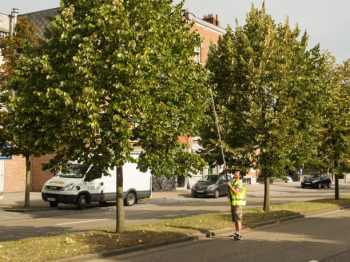
The aim is (i) to provide an assessment of the EcM community and functional group composition of urban trees, and of its environmental drivers, using next generation sequencing techniques; (ii) to relate specific EcM, or functional groups of EcM, to tree health, and tree ecosystem service delivery and resilience, using advanced noninvasive spectral and physiological sensing technology, diameter growth measurements, and urban biophysical modeling; and (iii) to develop and test (in situ & ex situ) a dedicated EcM-inoculum to improve urban tree health, and ecosystem service delivery and...
The main objective of our BIOVEINS proposal is to use functional diversity (FD) to highlight the mechanisms underpinning the link between GBI, taxonomic diversity (TD) and ecosystem services (ESs) provisioning, and to provide, together with local stakeholders, the ecological and interdisciplinary knowledge to identify the critical features of GBI, to guide the establishment, management and restoration of GBI, and to mitigate the effects of major urban global challenges, like habitat fragmentation, air pollution, and urban heat island.
This main objective will be accomplished by...

Foster sustainable urban planning and management through the integration of ecosystem services in existing decision-support tools, focussing on both the provision and the demand of the ecosystem services.
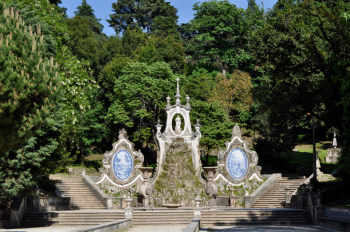
The aim is to develop realistic indicators to evaluate, manage and develop performant GBIs in cities and intensively managed landscapes. UrbanGaia explicitly focusses on analysis of ecological and socio-economic features of the many existing GBIs within a place-based and socio-ecological research framework. The project consists of three main approaches which converge in a transdisciplinary analysis of GBI performance: ecological science, political economic analysis and stakeholder co-creation.

Ecological enhancement of hard coastal structures. Project aimed to mitigate expected habitat losses associated with improving coastal defences for both the natural substrate & pre-existing defences within Natural 2000 site, & minimise future habitat losses due to sea level rise & coastal squeeze.