
Products
Filters
Marketplace

- Document
- Guidance
FINAL REPORT – EKLIPSE REQUEST ON SUPPORTING EU NEGOTIATORS AT IPBES PLENARY
This report provides the summary of findings by the EKLIPSE ‘Expert Working Group analysing the links between the IPBES Global Assessment (GA) and its Summary for Policymakers (SPM). The Expert Working Group (EWG) was established based on a request by the European Commission, DG Environment, and
- Document
- Training
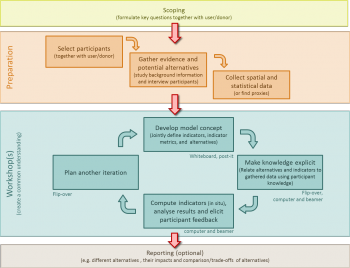
Method Factsheet - Quickscan
The QUICKScan software and QUICKScan tool (http://QUICKScan.pro) encompasses a modelling environment with functionalities to assess societal and environmental conditions, diagnose patterns and interactions, implement alternative responses and evaluate the impacts of those responses. The QUICKScan
- Document
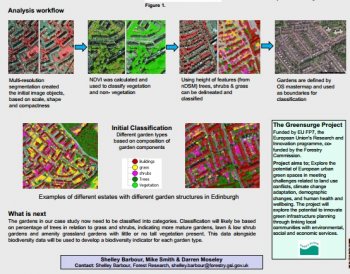
Using Object Based Image analysis to delineate garden structures in an urban environment
The accurate identification of greenspace typologies enables assessment of the contribution that urban greenspaces make to biodiversity, improving peoples well-being and the green economy, a focus of the EU FP7 project GREENSURGE. It has been shown that the conventional pixel by pixel

- Document
- Training
Method Factsheet - Shadow Pricing
Shadow pricing is highly appropriate to elicit monetary values and anthropocentric instrumental values of nature's benefits. When society sets environmental targets on the provision of non-marketed ecosystem services it is an implicit valuation of the services. The shadow price is the marginal

- Dataset
Urban Nature Atlas
The Urban Nature Atlas is a repository that contains 1000 examples of Nature-Based Solutions from across 100 European cities. You can use the Search icon to identify the projects fitting your interests. A map will be updated to display the results of your search, and a list of all relevant projects
- Document
Enhancing Additionality Assessment of Carbon Credit of Various Interventions by Utilizing Site-Specific Historical Data in Compliance with IPCC International Standards
In carbon credit additionality projects, precise quantification methods are crucial to prevent incorrect estimations. The project activities and results demonstrated that active forest management generates additionality and, consequently, carbon credits.
- Paper
Social innovation and temporary innovations systems (TIS): insights from nature-based solutions in Europe
The purpose of this paper is to examine the applicability of the complexity-based temporary innovation system (TIS) framework to social innovation and examine the extent to which “nature-based solution” (NbS) projects may be understood through a TIS lens. It is proposed that TIS provides a

- Empty
Visionary and integrated solutions to improve well-being and health in cities: Clustering Activities - Joint Manifesto
Report The following is a joint manifesto from four sister projects which calls on European cities to launch initiatives that offer visionary and integrated solutions at the intersection of social, cultural, digital and nature-based solutions (NBS) to increase the health and well-being of
- Document
- Guidance
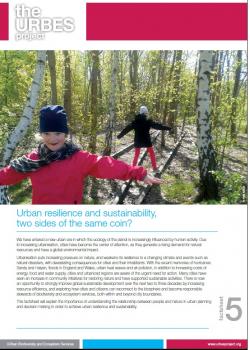
Urban resilience and sustainability - URBES Factsheet #5
This factsheet explains the importance of understanding the relationship between people and nature in urban planning and decision making in order to achieve urban resilience and sustainability.
- Report
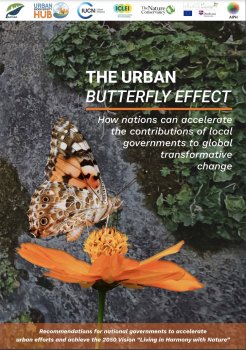
The Urban Butterfly Effect
"The Urban Butterfly Effect” a policy brief with recommendations for national governments to accelerate urban efforts to help them achieve the Global Biodiversity Framework (GBF) 2030 Action Targets. This policy brief is a response to the call from the Plan of Action on Subnational Governments
- Document
- Training
Method Factsheet - Photoseries Analysis
Revealed preference for Cultural Ecosystem Services (CES) and spatially-explicit data on location for nearby CES provision can be obtained from popular social networks. Photoseries databases can be acquired from photo-sharing websites such as Flickr, Panoramio and Instagram. The analysis of
- Guidance
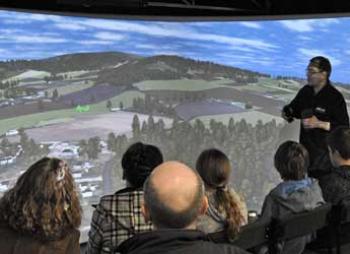
Virtual Landscape Theatre
The Virtual Landscape Theatre (VLT) is a mobile curved screen projection facility, in which people can be 'immersed' in computer models of their environment to explore landscapes of the past, present and future. This facility is the first mobile unit of its kind in the UK, and is used for
- Guidance
Bridging Worlds Crafting Future-Ready NbS Curricula for Global Sustainability and Justice
This report addresses the current competency and skill gaps among Nature-based Solutions (NbS) professionals, by proposing a set of impactful experiential and inclusive curricula approaches to higher education and professional training providers in Europe and Latin America. It proposes a NbS
- Guidance
- Paper
Barriers to ecological restoration in Europe: expert perspectives
Ecological restoration is key to counteracting anthropogenic degradation of biodiversity and to reducing disaster risk. However, there is limited knowledge of barriers hindering the wider implementation of restoration practices, despite high-level political priority to halt the loss of biodiversity
- Paper
- Report
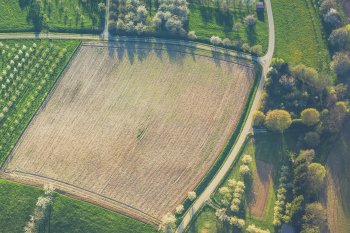
Agroforestry benefits nature, climate and farming
Agroforestry is a land management practice that combines cultivation and farming systems with trees and shrubs. It can include agricultural hedges, parks and wooded pastures, but also innovative systems, such as contour planting and forestry cultivation. This approach offers many benefits for both

- Web platform
VEG-GAP Information Platform
The VEG-GAP Information Platform is a web-based multi-purpose information platform exploiting the final results of the project. The platform uses Atmospheric Modelling Systems outputs. It is a collaborative framework among end-users (which can interact with data analytics), governance (facilitating

- Document
- Product
Conexus key learning factsheet series - Integrating intersectionality into urban NbS
Nature-based Solutions (NbS) interventions are embedded in settings where socio-environmental inequalities can be reinforced over time unless intentionally tackled. This factsheet highlights key learnings from co-designing and implementing more just and inclusive NbS, spanning experiences in

- Consultancy
- Document
- Training
Stated preference valuation
A family of techniques which use individual respondents statements about their preferences to estimate change in utility associated with a proposed increase in quality or quantity of an ecosystem service or bundle of services. Respondents are presented with one or more hypothetical policy or
- Policy Brief
Governance innovation for nature-based solutions - PBF Workshop Summary 24 March 2020
The Policy Business Forum (PBF) consists of Nature-based Solutions (NbS) experts and knowledgeable stakeholders at the international, European, and national scale. The main aim of the PBF is to explore innovative ways to strengthen the science-policy-business nexus in order to exploit opportunities
- ‹ previous
- 25 of 41
- next ›